In the global controlled-environment agriculture and modern horticulture supply chain, containers are no longer viewed as simple vessels for holding growing media. Instead, modern precision agriculture regards them as critical engineered components for regulating the root-zone microenvironment. Among the many available materials, plastic plant pots have become the preferred choice for large-scale agricultural operations, plant factories, and wholesale distributors worldwide due to their exceptional structural durability, customizable drainage systems, and outstanding cost-effectiveness.
Whether growers are managing large-scale greenhouse tomato production with integrated fertigation systems or producing plastic pot plants in high volumes for commercial wholesale markets, they must address one fundamental technical decision: how to select the ideal container size for a specific crop, growth cycle, and irrigation strategy.
Many inexperienced investors underestimate the importance of size standardization, only to face significant challenges later in automation, field logistics, and root health management. This article provides a comprehensive industrial and commercial perspective on the global sizing systems used for plant plastic pots, explores the plant physiology behind container volume and dimensions, and helps B2B procurement managers choose the most suitable planting pots plastic based on production and financial considerations.
Global Size Classification Systems for Plastic Plant Pots
In international B2B trade, growers and suppliers often use different measurement systems when describing plastic plant pots. Understanding the relationship between these systems is essential for avoiding costly specification errors across global supply chains.
The Trade Gallon System
In North America and many export-oriented agricultural regions influenced by U.S. standards, container sizes are commonly described using gallons. However, the horticultural industry’s “trade gallon” differs from the standard liquid gallon.
A standard one-gallon nursery container typically has an actual physical volume of approximately 0.75 liquid gallons, or roughly 2.8 liters. This convention originated from historical substrate handling practices and has remained an industry standard. Today, gallon ratings serve primarily as commercial identifiers rather than precise volume measurements.
The Metric Liter System
European and Asian agricultural markets, including China, Japan, and much of Europe, generally prefer the metric liter system.
Unlike trade gallons, liter ratings directly correspond to actual container volume. This system enables irrigation engineers and production managers to accurately calculate substrate requirements, including peat moss, coco coir, and perlite. Because liters integrate seamlessly with irrigation flow-rate calculations and automated fertigation systems, the metric system dominates highly digitalized greenhouse operations, particularly in advanced horticultural regions such as the Netherlands.
Diameter and Height Measurements
In manufacturing, plastic plant pots are ultimately defined by precise geometric specifications, including top diameter, bottom diameter, and height.
These measurements are critical for transportation efficiency, field spacing, automation compatibility, and shipping optimization. For example, a container labeled with a 15-centimeter diameter refers to its maximum upper width. By adjusting wall taper and depth while maintaining the same diameter, manufacturers can produce deep, standard, or shallow profiles to accommodate different crop growth habits and plastic pot plants.
Container Size Categories Throughout the Crop Lifecycle
Modern commercial crops typically undergo multiple transplant stages. Selecting appropriate plant plastic pots at each stage helps reduce substrate costs while maximizing production efficiency.
Small Containers for Propagation and Nursery Production
Small plastic plant pots ranging from approximately 2 to 5 inches or 0.1 to 1.5 liters are commonly used for tissue culture plants, seedlings, and young transplants.
Because these containers hold very small substrate volumes, they are often manufactured from lightweight polypropylene through thermoforming processes. They are arranged in dense nursery grids to maximize production capacity.
For these containers, drainage and aeration performance are critical. Small substrate volumes dry rapidly, requiring frequent low-volume irrigation. The primary objective during this stage is to develop compact, healthy root balls that can be transplanted efficiently into larger containers.
Medium Containers for Ornamental and Transitional Production
Containers ranging from approximately 6 to 10 inches or 2 to 7 liters represent one of the most important market segments in commercial horticulture.
Many foliage plants, flowering crops, and landscape shrubs are sold to end customers as plastic pot plants within this size range.
Because these containers must withstand longer production cycles and repeated handling, they are typically manufactured through injection molding. Reinforced rims and thicker walls provide improved durability, preventing deformation during transportation and nursery operations while protecting root systems from damage.
Large Containers for Commercial Fruit Production
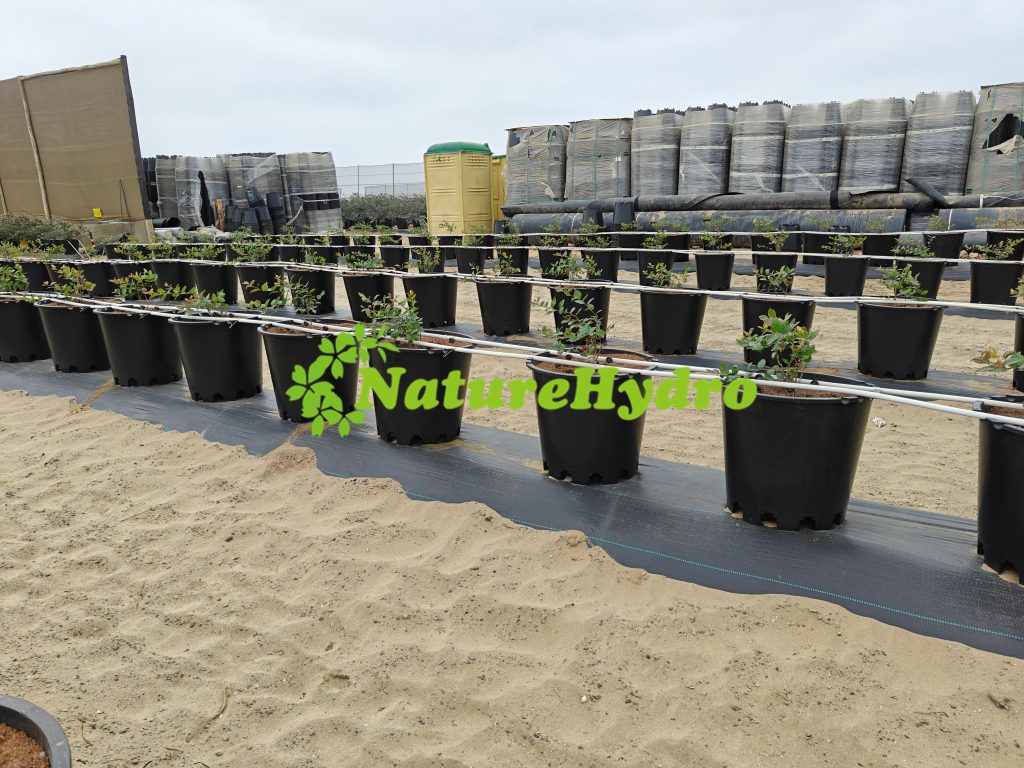
When commercial growers cultivate high-value fruit crops such as blueberries, raspberries, blackberries, figs, and citrus using substrate-based systems, plastic plant pots become heavy-duty production tools.
Professional growers frequently select containers ranging from 25 liters to 45 liters or larger for long-term cultivation. These large plant plastic pots must provide sufficient root volume for several years while resisting environmental stress.
Industrial-grade containers are typically engineered with UV-resistant materials and advanced three-dimensional drainage designs to ensure consistent root health and stable production throughout the crop’s productive lifespan.
Why Container Size Matters: A Root Physiology Perspective
Selecting the wrong container size can significantly impact crop performance. Scientific container selection should always be based on root system characteristics and plant physiology.
Taproot Systems vs. Shallow Root Systems
Different crops exhibit dramatically different root architectures.
Tomatoes, medicinal crops, and many woody ornamentals often develop deep root systems with strong downward growth tendencies. These crops benefit from deep plastic plant pots that allow unrestricted vertical root development.
In contrast, blueberries and strawberries possess shallow fibrous root systems concentrated near the substrate surface. These crops perform best in wider containers that provide greater horizontal growing space while avoiding unnecessary depth and substrate expense.
Preventing Root Binding
Plants grown too long in undersized plant plastic pots often develop root-bound conditions.
As roots encounter the container wall, they begin circling around the interior surface. Over time, these circling roots become thicker and increasingly congested, limiting the plant’s ability to explore fresh substrate.
Root-bound plants frequently experience reduced nutrient uptake, smaller fruit size, and lower productivity despite adequate irrigation and fertilization. Appropriately sized planting pots plastic delay root binding and help maintain peak crop performance throughout the plant’s economic lifespan.
Managing the Perched Water Table
All container-grown substrates develop a perched water table at the bottom of the container due to capillary forces.
The height of this saturated layer is determined primarily by substrate properties rather than container size. However, container height strongly influences how much of the root zone is affected.
In shallow containers, the perched water table may occupy a significant portion of the root zone, creating oxygen-deficient conditions that encourage root diseases. Taller plastic plant pots reduce the relative impact of this saturated zone, allowing most of the substrate profile to remain well-aerated and favorable for root growth.
The Relationship Between Container Volume and Fertigation Management
In modern greenhouse production, fertigation serves as the foundation of high-yield crop management. Container volume directly influences nutrient and water management strategies.
Buffering EC and pH Fluctuations
Crops such as blueberries and raspberries are highly sensitive to root-zone chemistry.
Small containers contain limited substrate volume, making them vulnerable to rapid changes in electrical conductivity (EC) and pH resulting from irrigation errors or unexpected weather events.
Larger planting pots plastic provide greater substrate volume, creating a natural buffer that stabilizes nutrient concentrations and root-zone chemistry. This stability supports consistent growth and reduces crop stress.
Temperature Buffering During Heat Events
As extreme heat events become more common, root-zone temperature management has become increasingly important.
Small containers can heat rapidly under direct sunlight, potentially exposing roots to damaging temperatures. Root systems subjected to prolonged temperatures above 35°C may experience reduced function, growth suppression, and lower yields.
Large plastic plant pots contain greater substrate mass and moisture reserves, providing thermal insulation that helps protect roots from temperature extremes. Even a few degrees of temperature reduction can significantly improve crop performance during heat waves.
Financial Advantages of Container Size Standardization
For large agricultural enterprises and commercial growers, container selection ultimately affects financial performance.
Eliminating Future Transplanting Costs
Some growers attempt to reduce initial capital expenditures by starting perennial crops in smaller plant plastic pots and transplanting them later.
However, large-scale transplanting operations generate substantial labor expenses and often damage valuable feeder roots. Production interruptions and transplant shock can significantly reduce yields.
Selecting appropriately sized planting pots plastic from the outset often provides lower total lifecycle costs while improving long-term productivity.
Aligning Container Lifespan with Asset Depreciation
Low-cost retail containers are often manufactured using lower-grade recycled materials and minimal UV stabilizers. Under harsh environmental conditions, these products may become brittle and fail within a short period.
Professional-grade plastic plant pots are typically produced using high-quality HDPE or copolymer polypropylene with advanced UV protection packages. These materials can withstand years of fertilizer exposure, sunlight, and mechanical stress.
When amortized across their full service life, premium containers frequently offer lower annual ownership costs than repeatedly replacing lower-quality alternatives.
Logistics and Transportation Considerations
In international B2B trade, logistics costs significantly influence total landed costs. Container geometry plays a major role in shipping efficiency.
Stackability and Anti-Lock Design
Well-engineered plastic plant pots are designed with optimized taper angles that maximize nesting efficiency.
This allows thousands of containers to be packed into a single shipping container, dramatically reducing transportation costs per unit. Anti-lock features prevent pots from becoming tightly wedged together during transit, enabling faster unloading and deployment at the destination.
Compatibility with Standardized Logistics Systems
Modern agricultural operations rely heavily on mechanized handling systems.
Standardized plastic plant pots are designed to integrate seamlessly with international pallet dimensions, automated potting equipment, forklifts, transport carts, and robotic handling systems.
Their reinforced rims and consistent dimensions improve operational efficiency throughout the supply chain while reducing labor requirements.
Conclusion
The precise selection of plastic plant pots for commercial substrate-based cultivation is far more than a simple purchasing decision. It is a strategic investment supported by agronomic science, engineering principles, logistics optimization, and financial analysis.
From supporting healthy root architecture and efficient drainage to stabilizing fertigation performance and reducing long-term operational costs, container size influences virtually every aspect of modern crop production. Large, standardized plastic plant pots provide the foundation for higher yields, improved quality, lower production risks, and stronger financial returns.
As global competition intensifies and labor costs continue to rise, growers who successfully standardize and optimize their container systems will be best positioned to maintain long-term profitability and competitive advantage within the international horticultural and fruit production industries.
Leave a Reply
You must be logged in to post a comment.